Citations that look real and are not.
AI can invent cases, quotations and holdings, and it formats them exactly like the real citations around them. A lawyer who files one has made a false statement to the court, whoever typed it.

Every law firm needs an AI governance program. NIRAP gives you the standards, tools, and verification to roll out an AI governance program in as little as one week.
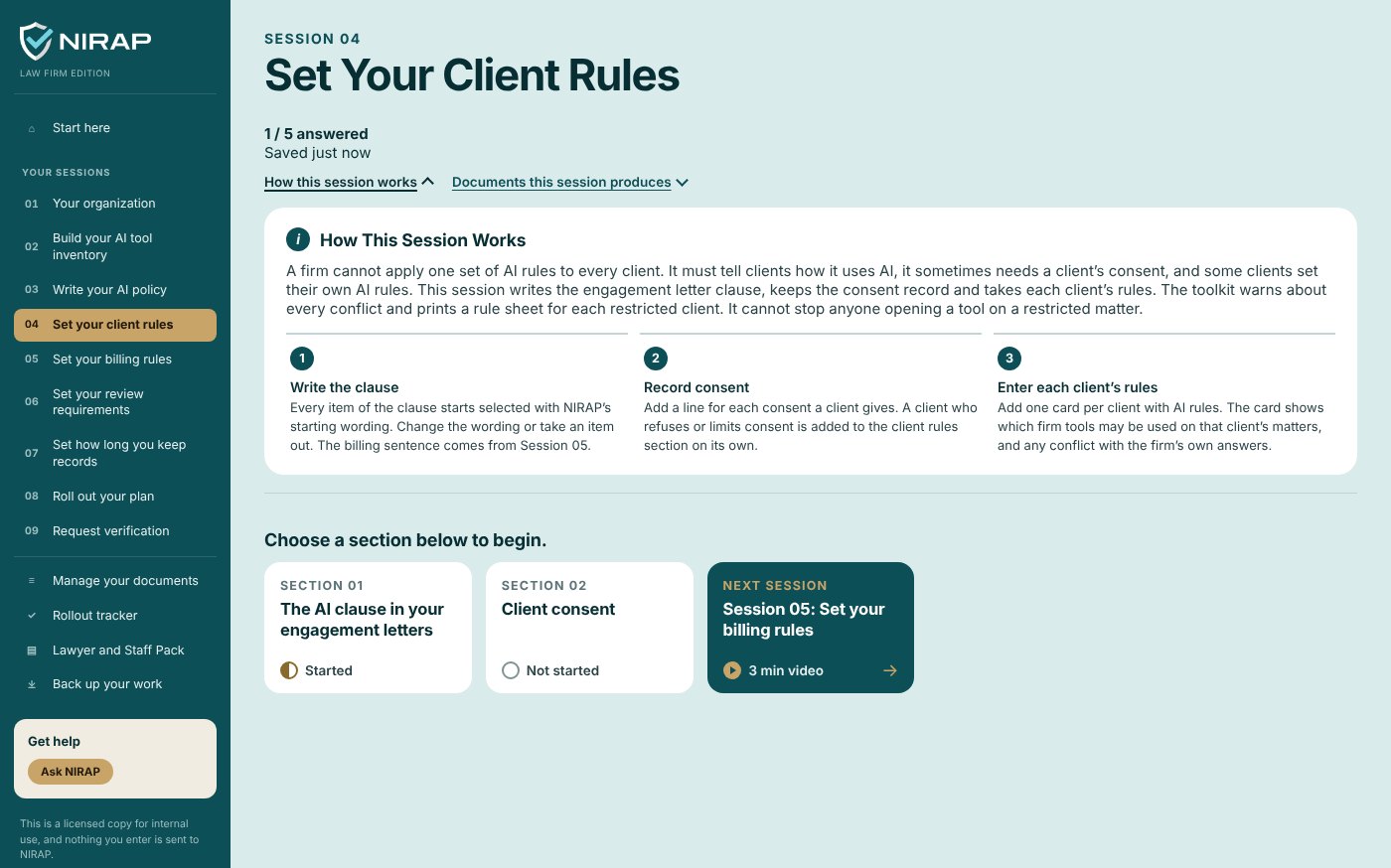 01ToolkitNine guided sessions
 02TrainingAI Governance 101
 03VerificationRAICB trust badge
Most firms are already partway through AI adoption. Here is how that journey tends to go when there are no rules, and where a governance program changes the ending.
AI tools draft briefs, summarize discovery and answer client email in minutes. That speed is real, and so are the risks that come with it. None of these risks need a new AI law to reach your firm, because the rules of professional conduct already apply to AI-assisted work.
AI can invent cases, quotations and holdings, and it formats them exactly like the real citations around them. A lawyer who files one has made a false statement to the court, whoever typed it.
Client facts pasted into a consumer AI tool can end up on a vendor’s servers, under terms that may let the vendor keep or use them. The duty of confidentiality does not pause because the tool was convenient.
AI tends to tell people what they want to hear. A lawyer who asks it to support a reading of a clause or the strength of a claim gets agreement, not a second opinion, and may then advise a client with confidence it has not earned.
AI vendor terms typically disclaim responsibility for accuracy and cap the vendor’s liability at what you paid. Some also claim the right to use what you type to improve their products. When the tool is wrong, the terms put the risk back on the firm.
The risk rarely comes from one bad decision. It comes from gaps that nobody owns.
ABA Formal Opinion 512 applies the duties your lawyers already owe, from competence and confidentiality to candor and supervision, to generative AI. State bars have added their own guidance, including Texas Opinion 705, and California has now written rules into statute. Corporate clients add another layer through the AI terms in their outside counsel guidelines. After an incident, a court, a disciplinary authority or a client could reasonably treat these as the measure of what the firm should have done. A firm that has not addressed them is exposed.
Lawyers and staff use personal accounts, free apps, and AI features that switched on inside research and practice software the firm already pays for. You cannot supervise tools you do not know about.
Without a written policy, each lawyer decides alone what AI may draft, what client information it may see, and whether anyone checks the result before it is filed.
Most lawyers and staff learned AI by trying it. Few know how it fails, or that the firm answers for what they file and send.
Someone clicked “I agree.” Nobody checked who owns the output, where client data goes, or who pays when the tool is wrong.
A client’s outside counsel guidelines restrict AI on its matters, and the associate staffed on the matter has never read them.
Nobody has decided how to bill for time a tool saved, or whether the client pays for the tool itself. Each lawyer answers the question differently on each invoice.
The case for a governance program does not rest on a future lawsuit. It rests on duties your lawyers owe today. Model Rules 5.1 and 5.3 require partners and supervising lawyers to make reasonable efforts to ensure that the lawyers and staff they supervise follow the rules. AI does not create an exception to those duties, and it does not move them to the software vendor.
ABA Formal Opinion 512 applies the rules lawyers already follow to generative AI. When an AI tool gets something wrong, responsibility rests with the lawyer and the firm, not the technology provider.
You do not need a malpractice suit for this to matter. A single AI-assisted brief or client memo can lead to a show cause order, a grievance or a lost client when it does any of these three things.
Invented cases, fabricated quotations, or pinpoint cites to pages that say something else.
A real case, described as deciding something the court never decided.
Client facts pasted into a public tool whose terms let the vendor keep them.
When that happens, the court, the bar and the client ask one question: What system did the firm have in place to prevent this?
can point to a written AI policy, a required citation check, and documented training. That is evidence the supervision duty was taken seriously.
has nothing on paper, and looks like a firm that failed a supervision duty it already owed.
You already have a duty to supervise. AI is a new way for lawyers and staff to create old problems, such as false statements to a court and breaches of confidence, and the ABA has already said the lawyer is still responsible. A governance program is how you show you took that duty seriously before something goes wrong.
Sooner or later, an AI mistake gets out. Opposing counsel flags a citation, or a client calls. What happens next depends on what you put in place before that day.
The associate fixes it quietly, if anyone notices at all. You hear about it from opposing counsel or the court.
Lawyers and staff know to report an AI error, and they know who to report it to.
There is no record of the tool, what it was given, or what it produced.
A dated incident log, and the originals your retention schedule told you to keep.
Whether to tell the client, the court or the malpractice carrier is decided on the spot, under pressure.
A written escalation card names who decides, and who tells the client, the court and the carrier.
A court, a disciplinary authority or a client will ask all three. Without documents, you have only your word.
The consequences land on the lawyer and the firm, not on the software vendor.
Courts that find AI-fabricated citations often refer the lawyers to their state bar. A referral turns one bad brief into a question about the lawyer’s fitness and the firm’s supervision.
Some liability policies now exclude claims that arise from generative AI. Check your own professional liability policy before you need it.
Sanctions opinions are published, reported in the legal press, and found by every client and recruit who searches the firm’s name.
What courts have already done
A governance program changes how this story ends. Your people can have every document written in one week.
See the nine sessionsThe toolkit breaks the work into nine sessions. Each session is a guided tool your people complete inside the app, and each one ends with finished documents for your firm, so nobody is left holding homework. At the end of the week your program is written and ready to roll out to your lawyers and staff.
Describe the firm: its size, practice areas, where its lawyers are licensed and file, and who must approve the policy. Your answers decide which documents the firm needs.
List the AI tools the firm uses, check each vendor’s security and contract terms, and record the tools your clients use.
Decide what AI may be used for, by which roles, and with what client information, including the personal AI tools people bring to work.
Decide when the firm asks a client for consent, and record each client’s own AI restrictions from its outside counsel guidelines.
Decide how the firm bills for time a tool saved, and whether it charges clients for the tool itself.
Define how a lawyer checks AI-assisted work before it is signed, filed, or sent to a client as advice.
Decide which AI records you keep and for how long, how you preserve them for a litigation hold, and who decides when something goes wrong.
Plan training, sign-offs, and a recurring audit of AI use, so the program is used and not just filed.
Gather your documents into one package and send it to NIRAP. A person reviews it against the V-AGE standard.
The toolkit produces up to 26 documents. Some are produced only when they apply to your firm: the Court Filing Check for firms that litigate, the client restriction documents for firms with institutional clients, AI Oversight Delegation for firms with more than one lawyer, and the Personal AI Tool Acknowledgment for firms that allow personal AI tools.
Nine working sessions. Up to 26 documents, written on the ABA Model Rules and Opinion 512, with Texas and California rules added where your lawyers practice.
 A step-by-step guided tool walks your people through each decision.
 The AI assistant drafts whatever the firm is missing.
 Each session ends with finished documents.
Send the link. Everyone who uses AI takes it, and the firm gets a named record for its AI Training Record.
In production. The Legal Edition is being made now and is included in the bundle when it is released. Until then, a firm may use its own AI training by sending NIRAP an outline.
Legal Edition · In productionVerification and the RAICB™ badge
RAICB™ certification is a point-in-time attestation, not a guarantee of legal, ethical or regulatory compliance.
Two things set the fee. The first is how many AI policies the firm needs. The toolkit produces one policy with its supporting documents, and a firm needs one for each state where it has an office, because the rules of professional conduct differ from state to state. A practice group that needs its own rules also takes its own policy. The second is how many lawyers the firm has, because every lawyer signs and sends work under the firm’s name. Paralegals and staff are not counted, because the lawyers are responsible for supervising them, and they take the training at no extra charge.
YOUR BUNDLE FEE
$2,995
Fill in the fee calculator to see your firm’s exact price, with a line-by-line breakdown.
$0
Included in the bundle
NIRAP, the National Institute for Responsible AI Practice, is a standards and certification body. We focus on professional services firms and individual professionals who license AI tools rather than build them. Most law firms fit that description.
Enterprise AI frameworks assume you have an engineering team. A law firm has partners, associates, paralegals, and staff. So we took the recognized frameworks and right-sized them for a firm like yours.
Most AI policies are written to say no. Ours are written so your lawyers can say yes safely. Adoption and governance should run side by side. You should not have to stop using AI to get it under control, and you should not have to accept unmanaged risk to keep using it.